
Custom Children's Book Manufacturing Process: From Concept to Delivery

Updated: Sep 16
Table of Contents
Custom Board Book File Preparation
Children's Book Safety Testing Compliance
Children's Book Manufacturing Timeline
Frequently Asked Questions
Last Updated: September 14, 2026
Custom Board Book File Preparation
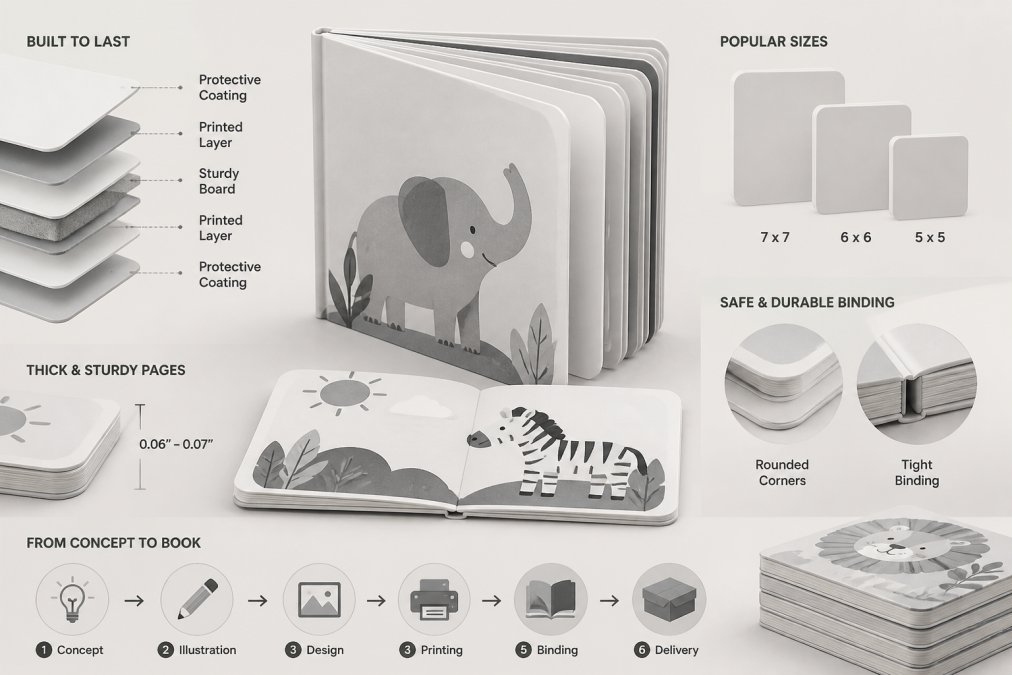
File preparation is where most custom children's book projects lose time, often because artwork was sized for a screen rather than a printed board book. Print-ready files need bleed on all four sides, CMYK color, 300 dpi illustrations at final size, and spine width calculated from page count and board thickness (Title Index). Keep manuscript text in a separate layer so typesetting can adjust leading and margins without disturbing the art. Board books are built from laminated paperboard, so file setup must account for that construction from the first draft.
Pro Tip Ask for the printer's file specification sheet before your illustrator starts. Redrawing art to match bleed and trim after the fact costs more time than building it correctly the first time.
Children's Book Safety Testing Compliance
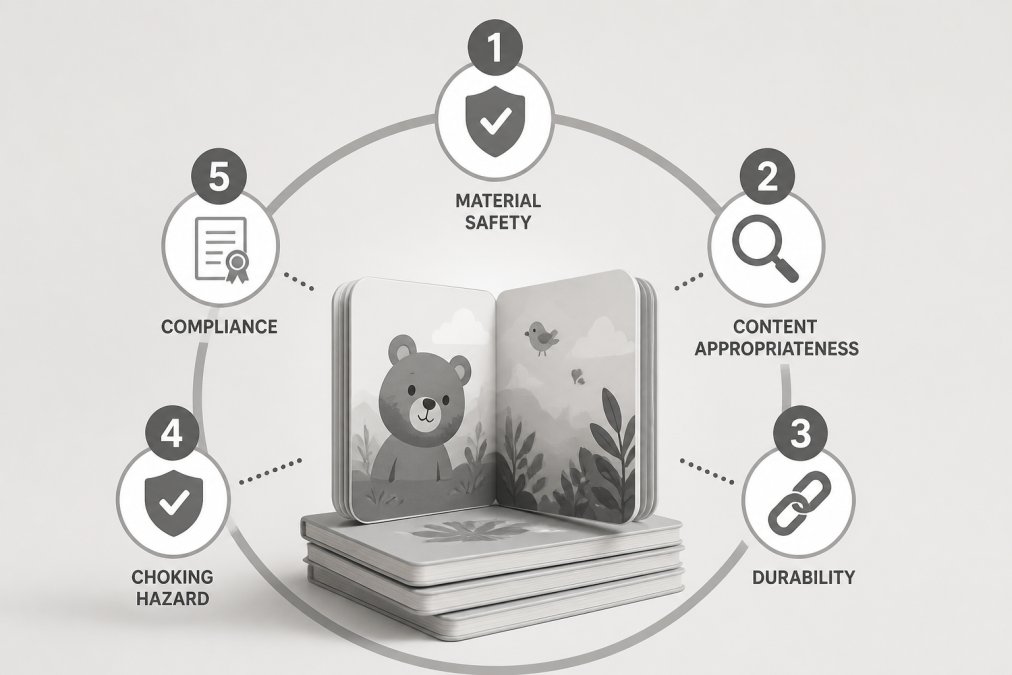
Safety testing compliance is a documentation exercise as much as a manufacturing one, and which requirements apply depends on age range, materials, and marketing. Confirm the applicable testing and documentation for your specific project rather than assuming a blanket certification covers everything. Child-safety compliance covers small parts, sharp edges, and material toxicity; environmental certifications cover sourcing, recycled content, or ink composition, and one does not substitute for the other (Children's Products). Playfield Books production include soy-based inks and UV varnish, a production detail rather than a safety guarantee on its own.
Watch Out Do not assume that because a material sounds natural or a finish sounds inert, it automatically satisfies child-safety requirements. Testing and documentation are project-specific, and skipping that step can stall a launch or force a reprint.
If you source from multiple vendors, ask each for testing documentation in writing.
Children's Book Manufacturing Timeline
A realistic timeline runs from concept through delivery, with each stage gated by an approval, and rushing any stage usually pushes the whole project back. The stages are concept and illustration, file preparation, proofing, printing and binding, safety testing, and delivery. Bulk offset printing makes sense when you need volume and want the per-unit economics to work; print-on-demand suits testing a concept or fulfilling individual orders, but rarely matches offset on cost at scale (Web Offset Lithography). Roughly 2-3 weeks illustration/design, digital proof, physical proof, then 2-3 weeks production.

Key Takeaway The proof copy is not a formality. It is the last cheap chance to catch a color shift, a trim error, or a binding issue before you commit to a full run.
Choosing a manufacturing partner comes down to whether they can carry a project from manuscript to delivered book without you stitching together five separate vendors. Playfield Books handles concept, illustration, design, printing, and delivery as a full-service studio, with digital and physical proofs provided for your approval before anything goes to press. To see the quality before committing, request a free digital sample spread.
Start your book with Playfield Books.
Frequently Asked Questions
What are the key stages in the custom children's book manufacturing process?
The process typically involves several key stages: concept development and illustration, file preparation, proofing, printing and binding, safety testing, and final delivery. Each stage is important for ensuring the final book meets your quality and safety standards. Working with a full-service partner can help manage these steps smoothly from start to finish.
How do I prepare my files for professional board book printing?
Proper custom board book file preparation includes formatting your manuscript, ensuring illustrations are high-resolution (typically 300 DPI), and setting up the correct bleed and trim sizes. It's best to consult with your printer for specific file specifications. A professional team can guide you through these technical requirements to avoid delays.
How do I ensure my custom board book meets child-safety standards?
To ensure children's book safety testing compliance, work with a manufacturer that provides documentation on material testing, ink, and coatings. It's important to confirm the applicable testing and documentation for each project, as requirements can vary. A reputable partner will provide this information transparently.
Request a Free Sample Spread

Comments