
Printing Board Books for Brands: A 2026 Guide

Table of Contents
Board Book Printing Specifications That Fit Your Brand
CPSIA Compliance for Custom Books: What Brands Need to Know
Branded Children's Books for Marketing and Customer Retention
Self-Publishing vs. Professional Printing for Board Books
Production Timelines, Minimums, and Cost Factors
Quality Control and Proofing: The Step That Protects Your Run
Marketing and Distribution: Getting the Book Into Homes
Sustainability and Materials: What to Ask About
How Long Does the Process Take From Concept to Delivery?
What If My Brand Has Never Made a Book Before?
Frequently Asked Questions
Last Updated: September 13, 2026
Board Book Printing Specifications That Fit Your Brand
Printing board books for brands starts with specifications, because the physical build determines how the book feels and how long it lasts. At Playfield Books, we handle concept, illustration, design, printing, and delivery as one process.
Specifications cover board thickness, page count, trim size, corner style, binding method, and finish. Board books are built from thick paperboard, and stock can be described by both its grammage (GSM) and its physical thickness.
Trim size and corner style come next: custom sizes let a book match product dimensions or fit small hands, while rounded corners are standard for young children. Binding and finishing round out the spec sheet, since thick pages bound edge to edge create a solid block that holds up to repeated page turning.
Page count: Short counts are typical, and page count drives cost and story pacing.
Trim size and orientation: Custom sizes are possible, so match the book to how it will be displayed or gifted.
Corner style: Rounded corners suit books handled by young children.
Finish: Lamination and coating affect feel and surface protection.
Paper stock: Stock weight and thickness affect the feel and rigidity of every page.
Pro Tip Ask for a physical proof before approving a full print run. Digital proofs confirm color and layout, but only a printed sample shows how the stock weight feels and how the corners and binding come together in hand.
CPSIA Compliance for Custom Books: What Brands Need to Know
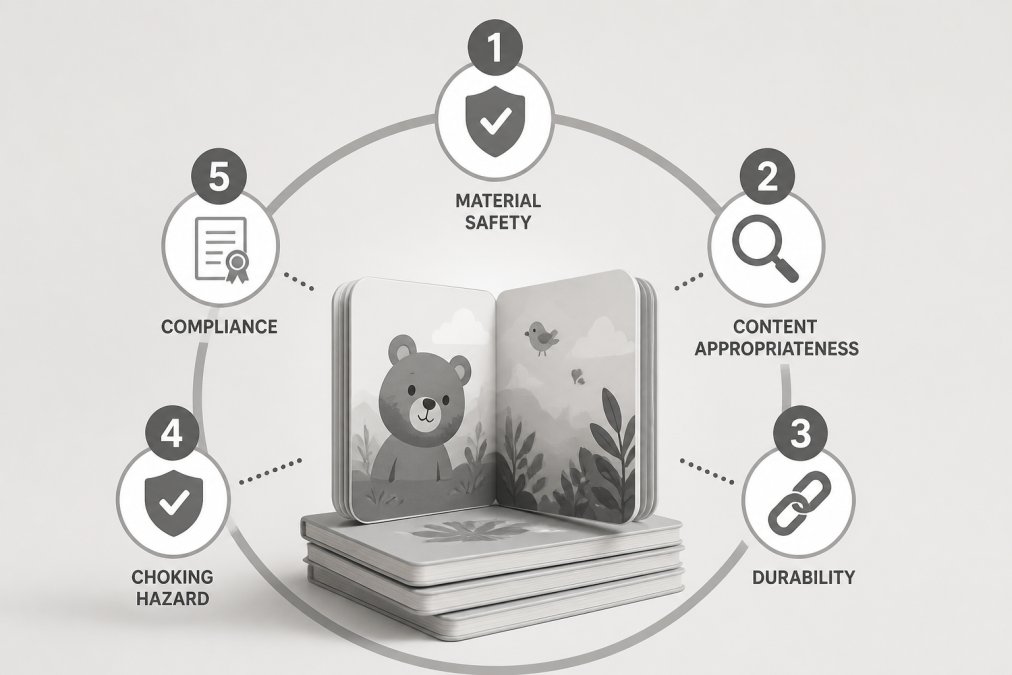
CPSIA compliance for custom books means confirming that the specific book you are producing meets the applicable federal requirements for children's products, and documenting that confirmation (cpsc.gov). Not every board book is subject to the same testing requirements, and it is not accurate to assume that all board books, or all materials, carry identical obligations.
Environmental certifications are often confused with child-safety compliance. A certification showing that a material meets an environmental or sourcing standard is not the same thing as a child-safety test result.
When discussing production with Playfield Books, our printing is aligned with MCRL Printing's published standards, which include soy-based inks and UV varnish. Material choices like these are one input into a compliance conversation, not a substitute for it.
Which federal children's product requirements apply to your specific book
What testing and documentation your printer provides, and for which components
Whether the applicable testing is current for the materials in your run
How certifications are described in your own marketing, so environmental claims are not presented as safety claims
That you have the paperwork on file before the book reaches customers
Watch Out Treating an environmental certification as proof of child-safety compliance is a common and costly mistake. They are separate standards, so confirm the specific testing and documentation that applies to your project.
For authoritative guidance on which requirements apply, review the Consumer Product Safety Commission guidance on children's product safety directly, and confirm the details for your specific book with your printer rather than relying on general assumptions.
Branded Children's Books for Marketing and Customer Retention
Branded children's books for marketing work because they occupy a different category than typical merchandise. A book gets read at bedtime, repeatedly, by a parent and a child together, and that repetition builds the emotional connection.
The business case has two sides: retention, since a book on a family's shelf keeps your brand present long after a purchase, and revenue, since a book can be sold as its own product.
Getting there requires the story to actually work as a board book. A brand mission does not automatically translate into a children's story, and the most common mistake is treating the book as a brochure with pages.
Customer retention: A book included with a purchase or sent to loyal customers as a thank-you.
Product launches: A story that introduces a new product or character to families.
Events and education: Durable books used by educators, therapists, and family-focused organizations.
Direct revenue: Books sold as a standalone product line, arriving ready to sell.
Key Takeaway A branded board book earns its place in the home by being a good book first. When the story stands on its own, the branding works quietly in the background every time a parent reads it aloud.
Self-Publishing vs. Professional Printing for Board Books
Self-publishing a board book and working with a professional printing partner solve different problems. Self-publishing gives an author control over the release and the rights, while professional printing gives the project the production quality, durability, and finish that board books require to survive actual use.
The practical difference shows up in file preparation and proofing. Board books have specific requirements for bleed and margins, and a file that looks correct on screen can fail at the trim stage if those margins are wrong. Professional production includes a proof stage, where digital and physical proofs are reviewed and approved before the full print run begins.
Where a full-service studio differs from coordinating a designer and a printer separately is that the handoffs disappear. Concept, illustration, design, printing, and delivery sit with one team, which removes the back-and-forth that causes delays and mismatched expectations.
Production Timelines, Minimums, and Cost Factors
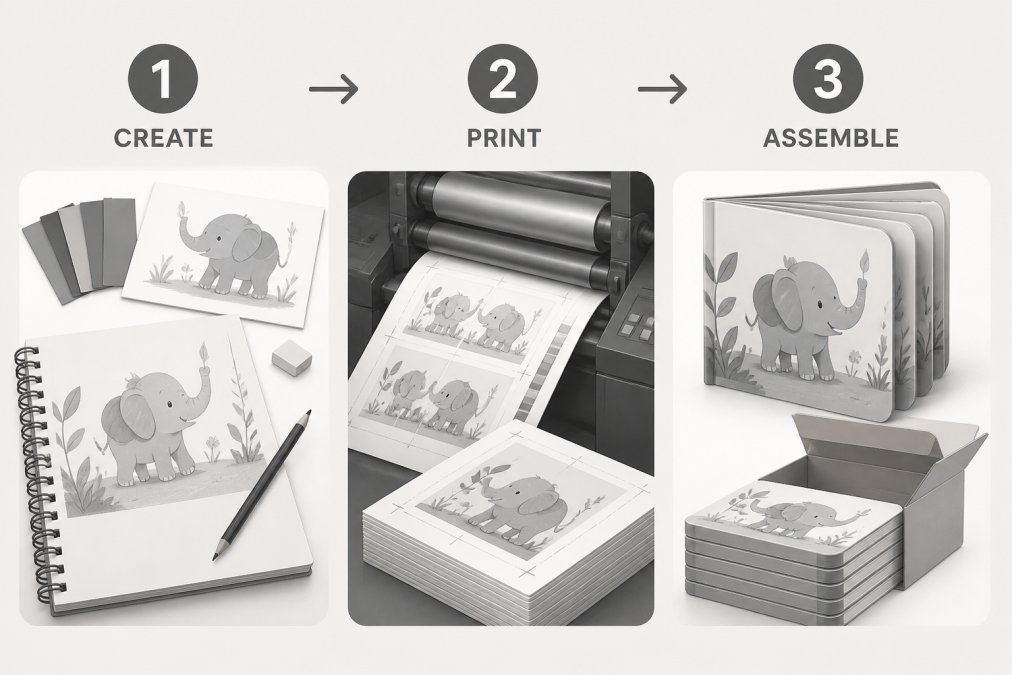
Production timelines depend on the scope of the project, and the honest answer is that a custom board book is not a print-on-demand product. A custom board book involves concept development, illustration, design, proofing, and then a print run.
Cost-per-unit is driven by quantity, page count, trim size, paper stock, finishing choices, and whether illustration and design are part of the scope, so the most accurate way to get a real number is to describe your project and request a quote.
Minimum order quantity is a real constraint in this format. Playfield Books has a minimum order of 500 books, which reflects how board book manufacturing works: setup, proofing, and a print run all have fixed elements that make very small runs impractical. If you are a smaller brand, the useful way to think about 500 units is not as inventory risk but as a first print run you can test, sell, and reorder from.
Decision | What It Affects | What to Confirm |
Paper stock (GSM) | Durability and feel | Weight suits the intended age range |
Trim size | Display, gifting, handling | Fits your packaging and shelves |
Corner style | Safety and finish | Rounded corners for young children |
Page count | Cost and story pacing | Story fits the format |
Quantity | Cost-per-unit | Meets the minimum run |
Proofing | Final quality | Digital and physical proofs approved |
Pro Tip Order a free digital sample spread before committing to a project. It gives you a preview of the concept, illustration direction, and how your brand could translate into a children’s book before moving forward.
Quality Control and Proofing: The Step That Protects Your Run
Quality control in board book printing happens at the proof stage, before the press run, not after. The process runs in a clear order: concept and illustration are approved first, design and file preparation follow, then proofs are produced and reviewed, and only after approval does the print run begin.
What most guides miss is that the proof is not a formality. It is your last low-cost opportunity to catch a problem, and issues like a color that reads differently than expected or a margin that sits too close to the trim are fixable at proof and expensive to fix after printing.
Watch Out Approving a proof without reviewing it carefully is the mistake that costs the most. Once a print run is complete, changes mean a new run, not a correction. Read every page of the proof as a finished book, not as a file.
Marketing and Distribution: Getting the Book Into Homes
A finished board book needs a plan for how it reaches families, and most brands already have the channels. If you sell direct to consumers, the book slots into your existing store and email flow; if you sell wholesale, it can sit alongside your other products; and if you use events, it becomes something people take home and keep.
Where will the book be sold? Direct, wholesale, events, or a mix.
How will it be positioned? As a standalone product, a gift with purchase, or a loyalty reward.
What is the reorder plan? A first run that sells well should be repeatable.
How will shipping work? Bulk printing means shipping logistics matter, so plan storage and fulfillment before the books arrive.
Books that arrive ready to sell remove a step that trips up a lot of first-time projects. The run lands and goes straight into the channel you already use.
Sustainability and Materials: What to Ask About
Sustainability questions come up in nearly every custom book conversation, and they deserve direct answers rather than vague assurances. Ask specifically about the materials in your book: the paperboard, the inks, the coatings, and the adhesives.
Playfield Books production aligns with MCRL Printing's published standards, which include soy-based inks and UV varnish. If sustainability matters to your brand, ask about these specifics rather than accepting a general claim, and be precise in how you describe them to your own customers.
Keep this separate from child-safety compliance in your own messaging. They are different conversations with different documentation, and blending them weakens both.
How Long Does the Process Take From Concept to Delivery?
Timelines vary with scope, and the honest answer is that concept development and illustration usually take longer than the printing itself. A book with original illustration and a multi-spread story takes longer than a simpler design, and revisions at the proof stage add time.
The practical move is to work backward from your target date. If the book needs to be in customers' hands for a specific launch or season, start the concept stage early enough to leave room for illustration and proofing, and ask your printing partner for a realistic schedule based on your specific scope.
What If My Brand Has Never Made a Book Before?
Plenty of brands start here, and the question of whether a brand story will work as a board book is a good one to ask at the concept stage. The answer usually comes down to whether there is a real narrative underneath the mission. If there is, a full-service studio can help shape it into a story that works across the spreads you have.
The way to find out without committing to a full run is to start with the concept and a sample. You see the direction, the illustration style, and the physical proof product before the print run begins.
Making a custom board book is a real production project, not a quick print job, and the brands that get the best results treat the specification, compliance, and proofing stages as the heart of the work. Playfield Books handles concept, illustration, design, printing, and delivery as one process with no agency overhead, provides digital proofs for approval, and produces child-safe, durable books built for children, with a minimum order of 500 books. Start your book with Playfield Books and turn your brand story into something families keep on the shelf.
Frequently Asked Questions
What are the minimum order quantities for custom board books?
Minimum order quantities vary by provider and project. Playfield Books has a minimum order of 500 books. This threshold supports efficient custom printing runs while giving brands enough inventory for launches, events, or ongoing customer retention programs. If you are a smaller e-commerce brand, 500 units can feel like a significant commitment, so it helps to plan your distribution strategy before ordering. Requesting a free sample spread lets you evaluate quality before committing to a full print run.
How do I ensure my branded board books meet child safety standards?
Child safety compliance depends on the specific materials, inks, coatings, and construction methods used in your project. Not all board books are subject to identical CPSIA, ASTM F963, or phthalate testing requirements. Ask your printer which tests apply to your book and request documentation for each production run. Environmental certifications are separate from child-safety compliance, so review both. Confirm the applicable testing and documentation for your specific project before going to print.
What is the difference between board book printing and standard book printing?
Board books use thick, durable paper stock and sturdy binding designed for young children. Standard books use thinner paper and lighter binding. Board book printing specifications include rounded corners, thicker pages, and materials that withstand repeated handling. These differences affect cost-per-unit, production timeline, and file preparation requirements. If your goal is a branded children's book for marketing or customer retention, board book construction offers the durability families expect from a product meant to be used, not just read once.
Request a Free Sample Spread

Comments