
How to Verify Children's Book Safety: 5 Checks

Table of Contents
Why Verifying Children's Book Safety Matters More Than You Think
How to Verify Children's Book Safety: A Step-by-Step Guide
4 Common Compliance Mistakes to Avoid
Frequently Asked Questions
Last Updated: September 7, 2026
Why Verifying Children's Book Safety Matters More Than You Think
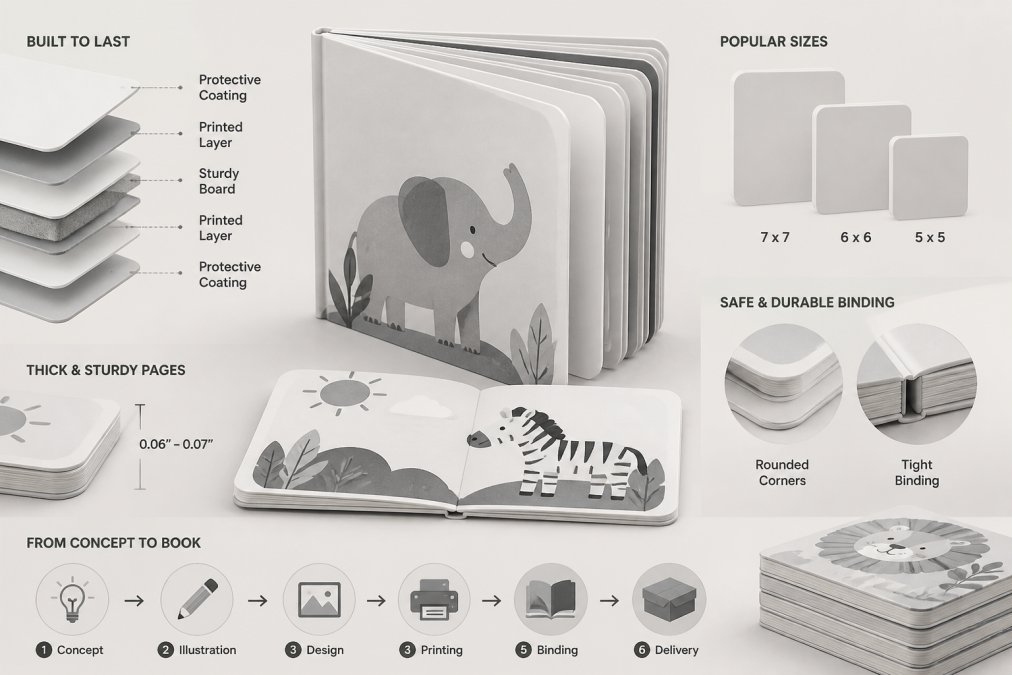
A board book for a toddler will be chewed, drooled on, and bent backward with surprising force. Verifying children's book safety means confirming the materials, inks, and binding can withstand heavy use without posing a hazard.
Verifying children's book safety is due diligence that protects young readers and your brand's reputation.
How to Verify Children's Book Safety: A Step-by-Step Guide
Children's book safety is confirmed through documented testing, manufacturer transparency, and your own systematic review of the paperwork.
Step 1: Request the Children's Product Certificate (CPC) (if applicable). The CPC is a document from the manufacturer or importer certifying that the product complies with applicable federal children’s product safety requirements, based on required testing. The certificate should identify the specific safety rules that apply to your particular book. Step 2: Confirm third-party testing was performed. When testing is required, ask for documentation showing that it was completed by a CPSC-accepted laboratory. Testing requirements can vary depending on the book’s intended age range, materials, construction, and features.
Step 3: Verify lead content limits and heavy metal testing. Confirm the report shows compliance with the current lead limit and that testing covered other heavy metals like cadmium (cpsc.gov).
Step 4: Check age grading and labeling. Confirm the age range is accurate and any required cautionary labeling is present.
Step 5: Review the manufacturing documentation. A printer should be able to discuss quality control processes, including material sourcing, ink types, and binding integrity tests.

Pro Tip Make sure the test report is from the specific batch or production run of your book, not a similar product from the same factory.
4 Common Compliance Mistakes to Avoid
Mistake 1: Assuming all printers are the same. Ask pointed questions about testing and documentation.
Mistake 2: Relying on a verbal "it's safe." A promise is not proof. You need the physical documentation: the CPC and the lab report, requested in writing.
Mistake 3: Overlooking the binding and construction. A book that falls apart can create a choking hazard. Ask about the binding method and integrity testing.
Mistake 4: Confusing environmental claims with safety. A printer may advertise soy-based inks or recycled paper. While positive attributes, they are not the same as a safety certification. The distinction between eco-friendly and child-safe is an important one for compliance purposes. You must still verify the product meets applicable safety standards.
Common Mistake | The Real Consequence | How to Avoid It |
Assuming all printers are compliant | A product that fails to meet standards | Ask for proof of testing and documentation |
Relying on verbal assurances | No evidence for your records | Require a CPC and a lab report |
Overlooking binding integrity | A choking or injury hazard from loose parts | Inquire about binding test methods |
Confusing "green" with "safe" | Missing a critical safety requirement | Separate environmental and safety compliance |
Watch Out Skipping the documentation review is the single riskiest move you can make. If a safety issue is discovered, you will be asked for your compliance file; without a complete record from an accredited lab, you have no defense and face a potential recall.
Verifying children's book safety is manageable when treated as a standard part of your production workflow. By demanding proper documentation, you protect the children who will enjoy your book and the business you are building.
Frequently Asked Questions
What is the difference between CPSIA and ASTM F963 standards for books?
CPSIA is the overarching consumer product safety law, while ASTM F963 is a specific safety standard referenced by it. For children's books, CPSIA sets mandatory limits for lead and phthalates. ASTM F963 includes requirements for physical hazards, like choking risks from detached parts. A compliant book typically meets both, but CPSIA compliance is a legal requirement.
Does a children's book need to be CPSIA compliant?
Yes, if it is intended for children 12 and under, it is subject to CPSIA. This requires third-party testing by an accredited laboratory for lead and other hazards. You must also have a Children's Product Certificate (CPC) to accompany the product. Always confirm with your manufacturer that they have the required documentation.
What documentation is required to prove a children's book is safe?
The most critical document is the Children's Product Certificate (CPC), which certifies compliance with applicable rules. You should also request the test report from the accredited third-party laboratory. This report details the specific tests performed, such as those for lead content and physical hazards, and the results.
Request a Free Sample Spread

Comments